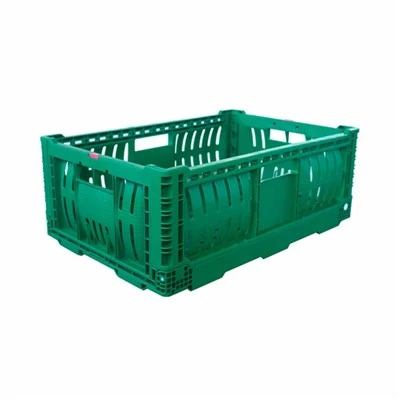
Products Description
Heavy-Duty Industrial Stackable Plastic Containers | Engineering & Sourcing Guide
Industrial operations require robust material handling solutions that withstand high static loads, automated conveyor friction, and repetitive impact. Engineered from virgin high-density polyethylene (HDPE) or polypropylene (PP) via high-pressure injection molding, these stackable plastic containers provide consistent dimensional stability for automated storage and retrieval systems (AS/RS), assembly line kitting, and closed-loop distribution.
Technical Specifications & Selection Guide
Selecting the correct container prevents structural failure, conveyor jams, and inventory damage. Review the standard configuration parameters below.
|
Model Series |
External Dimensions (L x W x H) |
Bottom Type |
Static Load Capacity |
Dynamic Load Capacity |
Nesting Ratio / Return Volume Reduction |
Material Grade |
Operating Temperature |
3D CAD Data |
|
ST-40030 |
400 x 300 x 140 mm |
Ribbed / Reinforced |
150 kg |
30 kg |
Non-nestable (Straight wall) |
Virgin HDPE |
-20°C to +60°C |
[STEP / IGES] |
|
ST-60040 |
600 x 400 x 220 mm |
Smooth Grid |
300 kg |
50 kg |
Non-nestable (Straight wall) |
Virgin PP |
-20°C to +70°C |
[STEP / IGES] |
|
ST-80060 |
800 x 600 x 320 mm |
Solid / Double-Wall |
500 kg |
80 kg |
Non-nestable (Straight wall) |
Virgin HDPE |
-30°C to +50°C |
[STEP / IGES] |
Material & Manufacturing Process
Durability depends directly on polymer selection and tooling precision.
Polymer Matrix: Molded using 100% virgin HDPE or impact-modified PP. Recycled blends are restricted strictly to non-load-bearing secondary applications unless specified for sustainability compliance.
Injection Molding Parameters: Processed on 800-ton to 2800-ton dual-circuit injection presses. Controlled melt temperature (210°C - 250°C) and high injection velocity eliminate internal micro-voids and knit-line weakness.
Structural Ribbing: Perimeter reinforcement ribs and corner gussets transfer vertical load vectors away from sidewalls, preventing bowing when stacked to maximum height.
Ergonomic Integration: Molded-in pass-through handles or shell grips rated for manual lifting up to 25 kg per ergonomic safety standards (NIOSH guidelines).
Application-Specific Suitability
Automated Warehousing & Conveyor Systems
Design Feature: Flat, ribbed base plates engineered with a deflection tolerance under 1.5 mm across roller spans.
Operational Benefit: Prevents tracking deviation, roller jam-ups, and sensor misreads on high-speed belt and gravity roller lines.
Automotive Component Kitting (WIP)
Design Feature: Oil-, grease-, and solvent-resistant polymer formulation paired with custom thermoformed ESD-safe or soft-foam dunnage inserts.
Operational Benefit: Protects Class-A machined metal and electronic sub-assemblies from surface scratching and electrostatic discharge.
Cold Chain & Food Processing Facilities
Design Feature: Non-porous, smooth inner walls that prevent bacterial harbor, resistant to sub-zero embrittlement down to -30°C.
Operational Benefit: Complies with FDA 21 CFR 177.1520 standards for direct food contact and withstands industrial steam sanitation cycles up to 90°C.
Quality Control & Testing Protocol
Every production batch undergoes strict verification before export release:
Load Testing: Vertical compression testing executed via hydraulic press to 150% of rated static capacity over a 24-hour dwell period.
Drop Impact Testing: Drop-tested at -20°C from a height of 2 meters onto concrete surfaces to verify low-temperature impact strength without brittle shattering.
Dimensional Metrology: Coordinate Measuring Machine (CMM) audits verify corner squareness, wall thickness uniformity (± 0.15 mm tolerance), and lip-to-base interlocking clearance.
Certifications: ISO 9001:2015 manufacturing facility, ISO 14001 environmental management, REACH and RoHS compliant raw material documentation.
FAQ
Q: What is the maximum safe stacking height for loaded containers?
A: Maximum stacking height depends on total weight and floor stability. As a rule, total stacked weight must not exceed the bottom container's static load rating. For standard warehouse floors, a maximum vertical stack of 5 meters or 6 tiers of fully loaded 600x400 mm boxes is recommended.
Q: Can these containers be customized with company logos or RFID tags?
A: Yes. Hot-foil stamping, screen printing, and permanent molded-in text/logos are available for identification and asset tracking. Recessed pockets are integrated into sidewalls for barcode labels or embedded RFID tags.
Q: How do nestable containers differ from stackable containers?
A: Stackable containers feature vertical, straight walls and reinforced rims that support upper loads. Nestable containers feature tapered walls, allowing empty units to slide inside one another to reduce return shipping and storage volume by up to 70%.
Q: What is the minimum order quantity (MOQ) for custom colors or dimensions?
A: Standard colors (RAL 5002 Blue, RAL 7001 Grey) are available from stock with flexible MOQ (1 pallet). Custom colors require an MOQ of 500 units per SKU. Custom mold tooling projects require a minimum volume agreement.
Request a Technical Quote, 3D CAD, or Sample
To evaluate container specifications for your facility, provide the following parameters in your inquiry:
Target application (Automotive, Food, General Warehousing, AS/RS automation)
Required external dimensions and load capacity per box
Operating temperature range and chemical exposure requirements
Estimated annual volume and destination port
[Request Engineering Quotation] | [Download 3D CAD Drawing (STEP/IGES)] | [Download Technical Datasheet (PDF)]
Hot Tags: stackable plastic container, China stackable plastic container manufacturers, suppliers, factory